 5.0 Out Of 250+ Reviews


 Financing Available


 (214) 227-2763

Quick Summary
A storm chasing contractor is a roofer who moves into an area only after a severe weather event, usually with no local address, license, or track record. Predatory operators use door-to-door pressure, upfront payments, and insurance promises to take advantage of homeowners facing urgent storm damage.
- Be wary of demands to sign today, since legitimate contractors give you time to review a written proposal.
- Full payment upfront is a red flag; reputable contractors usually tie payments to milestones.
- Only a licensed public adjuster can represent you in most states, not a contractor handling your claim.
- Avoid assignment of benefits documents, since they can transfer control of your insurance claim to the contractor.
- Verify the state license, insurance certificate, and business address before signing anything.
Table of Contents
- Why Storm Damage Attracts Predatory Contractors
- Red Flags: Pressure Tactics and Door-to-Door Solicitation
- Red Flags in Payment and Insurance Promises
- How to Verify a Roofing Contractor’s Legitimacy
- Questions to Ask a Roofing Contractor Before You Hire
- Storm Damage Contractor Checklist for Your Inspection
- What to Do After Signing a Roofing Contract or Hiring a Suspicious Contractor
- Frequently Asked Questions
Why Storm Damage Attracts Predatory Contractors
Last Updated: November 16, 2026
After a hailstorm or high-wind event, many homeowners face a roof that needs attention right away. That urgency is exactly what predatory storm chasers count on. These out-of-area operators travel to damaged neighborhoods, knock on doors, and push fast contracts before homeowners have time to compare options.
A storm chasing contractor is a roofer or exterior contractor who moves into an area only after a severe weather event, usually with no local address, license, or track record. Compare local contractors with storm chasers and learn how to verify licenses. Others take deposits, file claims on the homeowner’s behalf, or perform shoddy work and then disappear. Learn how to spot a storm chaser roofing scam and verify contractors before you sign anything.
Storm damage creates three conditions that make homeowners vulnerable:
- Time pressure, since leaks can cause interior damage within days
- Insurance uncertainty, since many homeowners do not know what their policy covers
- High demand, which pulls in more operators than local crews can handle
Understanding these conditions helps you recognize when a sales pitch is taking advantage of them. Most of the warning signs below follow directly from this pattern.
Red Flags: Pressure Tactics and Door-to-Door Solicitation
Door-to-door sales are not illegal, but they are one of the most common entry points for predatory storm work.
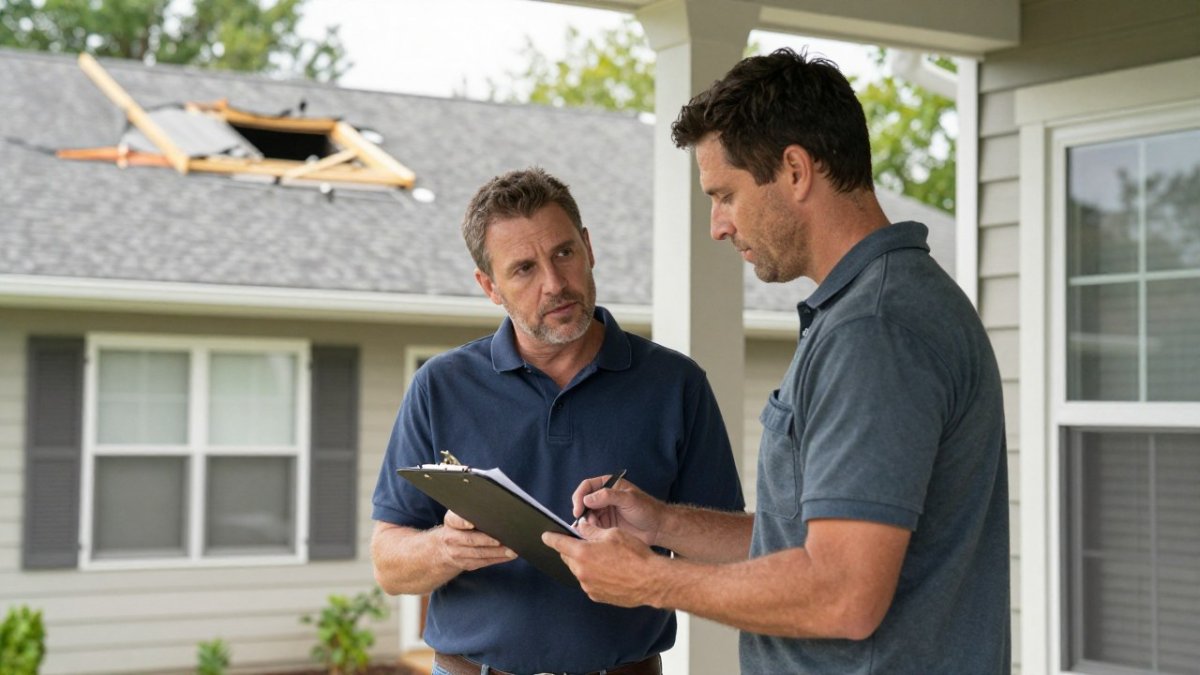
Watch for these pressure tactics:
- Demands to sign today. Legitimate contractors give you time to review a written proposal.
- Claims that the roof must be replaced immediately. Even when damage is real, a qualified contractor can explain what needs urgent temporary protection and what can wait for a proper estimate.
- Offers to “catch” your neighborhood’s discount. Pricing that depends on signing before a deadline is a warning sign.
- Reluctance to provide a physical business address. Many storm operators use a post office box or a temporary phone number.
Be wary of any contractor who asks you to sign a document you have not read or who refuses to leave written materials behind. Your rights as a homeowner include the right to take time to decide. If a contractor pushes back on that, treat it as a red flag.
Red Flags in Payment and Insurance Promises
Payment terms and insurance promises are where predatory operators do the most financial harm.
Assignment of benefits (AOB). Some contractors ask you to sign a document transferring your right to insurance proceeds to them.
What a contractor can and cannot do with your claim. A useful boundary to keep in mind:
- A contractor can inspect, photograph, and document damage.
- A contractor can provide an estimate and meet your adjuster on site.
- A contractor cannot negotiate policy coverage or interpret your policy for you.
- A contractor cannot settle your claim or sign documents on your behalf.
- A contractor cannot require you to use them for repairs in exchange for handling the claim.
If you want someone to represent you in the claim itself, a licensed public adjuster is the appropriate professional in most states.
The table below summarises the payment and insurance warning signs covered in this section.
| Red flag | What it looks like | Why it matters |
|---|---|---|
| Full payment upfront | Full contract amount requested before work begins | Removes the homeowner’s leverage if problems arise |
| Large deposit before materials | 50 percent or more demanded before any material arrives | Milestone payments are the reputable norm |
| Deductible waiver | Contractor says the deductible will be handled or waived | Often illegal in many jurisdictions and can signal an inflated claim |
| Handling the claim entirely | Contractor says they will deal with the insurer for you | Only a licensed public adjuster can represent you in most states |
| Assignment of benefits | Document transfers insurance proceeds to the contractor | You lose control over the claim and the right to dispute scope |
| Inflated damage estimate | Damage listed on every slope, even where the roof looks fine | Scope should reconcile with the adjuster’s findings |
How to Verify a Roofing Contractor’s Legitimacy
Verifying a contractor takes about thirty minutes and can prevent months of problems. Use this process before signing anything.
Check the license. Most states require roofing contractors to hold a state or local license. Look up the license number on your state licensing board’s website and confirm the business name, the license status, and any complaints or disciplinary actions. Understand why licensing matters and what to avoid.
Confirm insurance. Ask for a certificate of liability insurance and workers’ compensation coverage. Learn how to check roofing contractor insurance coverage before you rely on the certificate.
Verify the business address. Search the address on Google Maps and check whether it matches a real commercial location.
Check local references and reviews. Look for reviews on the Better Business Bureau, Google, and local community forums.
Our team at StormPros recommends keeping a written record of every check you complete.
Questions to Ask a Roofing Contractor Before You Hire
Asking direct questions is one of the fastest ways to separate reliable contractors from predatory ones. Ask each of these and compare the answers:
- What is your state license number, and what classification does it cover?
- Can you provide a current certificate of liability insurance and workers’ compensation coverage?
- What is your business address, and how long have you operated at that location?
- Will you provide a written contract with a detailed scope of work?
- What is your payment schedule, and what will I owe before work begins?
- Who handles permits, and does your bid include permit costs?
- What warranty do you offer on workmanship and materials, and is it in writing?
- Can you provide references from completed jobs in my area?
Pay attention to vague answers. A reputable contractor answers these questions without hesitation and puts the answers in writing.
Storm Damage Contractor Checklist for Your Inspection
Use this checklist during and after any inspection:
- The contractor showed you photos of each damaged area, not just general shots
- The written estimate lists materials, labor, and removal of old materials separately
- The scope of work matches what the insurance adjuster has documented
- Payment milestones are tied to completed work, not calendar dates alone
- Permit requirements are identified and assigned to a named party
- The contract includes a start date, a completion date, and a process for changes
- You received copies of all documents you signed
- Post-job inspection includes checks for flashing, vents, and gutter connections
Roofing-specific quality checks matter after the work finishes. Look for properly sealed flashing around chimneys and vents, consistent shingle alignment, and clean gutter attachment. Ask the contractor to walk the roof with you before final payment.
What to Do After Signing a Roofing Contract or Hiring a Suspicious Contractor
If you have already signed a contract or paid a deposit to a contractor you now doubt, act quickly. Follow five steps to secure the roof, document the job, and hire a replacement.
-
Check your cancellation rights under federal and state law. Federal rules may give consumers a short window to cancel certain contracts signed at the buyer’s home or outside the seller’s permanent place of business (Buyer’s Remorse: The FTC’s Cooling-Off Rule May Help). Check the current FTC guidance on the Cooling-Off Rule for the details that apply to your contract (Buyer’s Remorse: The FTC’s Cooling-Off Rule May Help). Separately, many states have their own home improvement or door-to-door sales cancellation statutes. Check your state attorney general’s consumer protection page for the specific rule that applies to your contract.
-
Send written cancellation if you are within the window. Do not rely on a phone call. Send a dated written cancellation by a method that produces proof of delivery, keep a copy, and note the deadline on your calendar. If the contractor did not give you the required cancellation notice, document that the notice was missing and confirm the effect with the FTC or your state attorney general.
-
Stop further payments and use traceable methods. Pay only by check or card so you have a record, and do not pay in cash. If you paid by credit card, contact the card issuer to ask about a dispute; if you paid by check, ask your bank about stop-payment options on any uncashed deposit check.
-
Document everything in one file. Save texts, emails, photos of the work and the damage, receipts, the signed contract, and any cancellation notice. Note dates, times, and the names of anyone you spoke with. This file is what your insurer, your state licensing board, and any attorney will ask for first.
-
Notify your insurance company in writing. Confirm what your adjuster has been told about the contractor’s role, whether any assignment of benefits was signed, and whether the contractor has been paid from claim proceeds. Ask your insurer to note the contractor’s conduct in the claim file.
-
Report the contractor to the right agencies. File complaints with your state licensing board (if the trade is licensed in your state), your state attorney general’s consumer protection division, and the Better Business Bureau. If the conduct involves insurance, a deductible waiver offer, an AOB, or a claim negotiation, also contact your state insurance department. Keep the complaint confirmation numbers.
-
Secure the property. If work stopped partway through, arrange temporary protection for the roof so further weather damage does not occur while you sort out the dispute. Photograph the current condition before any temporary work begins, and keep receipts for the temporary repairs, they may be recoverable under your policy.
-
Get a second written opinion before authorizing more work. Ask a licensed local contractor to inspect the property and put their findings in writing. Compare that scope against the original contract and the insurer’s estimate. A second opinion is often the fastest way to establish whether the first contractor’s scope was inflated.
Watch out: a contractor who asks you to sign a new document, a revised contract, a lien waiver, or a completion certificate, after you have raised concerns may be trying to reset your cancellation window or release their liability.
For help finding a reliable replacement, ask your insurer for a list of approved contractors and verify each one using the steps above.
Frequently Asked Questions
What are the warning signs of a storm-chasing contractor?
Common warning signs include contractors who knock on doors soon after a storm, pressure you to sign the same day, ask for full payment upfront, or offer to waive your insurance deductible. Predatory operators often have no local address, use out-of-state license plates, or refuse to provide proof of a state contractor license and liability insurance. Any contractor who offers to handle your insurance claim for you or inflates damage estimates should be treated with caution until verified.
How can I verify that a roofing contractor is legitimate?
Check the contractor’s license with your state licensing board, confirm active liability insurance and workers’ compensation coverage directly with the insurer, and verify a physical business address. Ask for local references and read online reviews, looking for a consistent history rather than a few recent ones. A reputable contractor will provide these documents without hesitation and will not object to you checking them.
Should I sign a contract with a contractor who knocks on my door after a storm?
Not on the spot. Door-to-door solicitation after severe weather is a common tactic, and a contract signed under pressure often includes vague scope of work or unfavorable payment terms. Take the contract home, compare it with at least two other written estimates, and verify the contractor’s license and insurance before committing. Legitimate contractors are willing to give you time to review.
Is it a red flag if a contractor offers to waive my insurance deductible?
Yes. Waiving or covering your deductible is generally prohibited in many states and can expose you to fraud charges. It also often signals that the contractor plans to inflate the claim to make up the difference. Ask the contractor to explain how this would work in writing, and check your state’s consumer protection resources if the offer is made.


