 5.0 Out Of 250+ Reviews


 Financing Available


 (214) 227-2763

Quick Summary
To check roofing contractor insurance coverage, request a current certificate of insurance and confirm it directly with the insurance carrier using the phone number on the carrier’s official website. Look for general liability and workers’ compensation coverage, matching named insured, and active policy dates covering the full job.
- Request a current certificate of insurance in writing before work begins.
- Confirm the policy number and coverage with the carrier, not the number printed on the certificate.
- Check that the named insured matches the company name on your contract.
- Ensure the policy dates cover the full expected completion date of the project.
- Ask for additional insured status and check subcontractors’ coverage too.
Table of Contents
- What a Certificate of Insurance Shows You for Roofing Work
- Why Verifying a Roofer’s Insurance Protects Your Home
- Step-by-Step: Requesting and Reading a Roofer’s COI
- Verifying Coverage Directly With the Insurance Carrier and State Resources
- Red Flags and What Happens If a Roofer Is Uninsured
- Questions to Ask a Roofer About Insurance Before You Sign
- Booking a Verified Roofer for Your Storm Repairs With StormPros
- Frequently Asked Questions
What a Certificate of Insurance Shows You for Roofing Work
For roofing work, a COI should show at least general liability coverage and workers’ compensation coverage. General liability protects your property if the crew damages something, such as a window, landscaping, or a neighbor’s car.
Read the COI as a list of facts to confirm, not a seal of approval. For more on spotting scams before you sign, see avoiding storm chaser roofing scams.
Why Verifying a Roofer’s Insurance Protects Your Home
Roofing is one of the highest-risk trades for falls and serious injuries, which is why roofing contractor insurance matters so much on any job. When an uninsured roofer gets hurt on your property, the medical bills and lost wages can land on you.
Storm damage makes the risk worse. After a major storm, many out-of-area crews move in fast, and some do not carry proper insurance. Verifying coverage before you sign protects you from:
- Liability for injuries on your property
- Damage the crew causes and does not pay for
- Work that stalls because the contractor disappears mid-project
- Warranty claims that go nowhere because the company is gone
Checking insurance takes only a short amount of time. Skipping it can leave you with significant financial exposure.
Step-by-Step: Requesting and Reading a Roofer’s COI
Step 2: Read the certificate top to bottom, in this order.
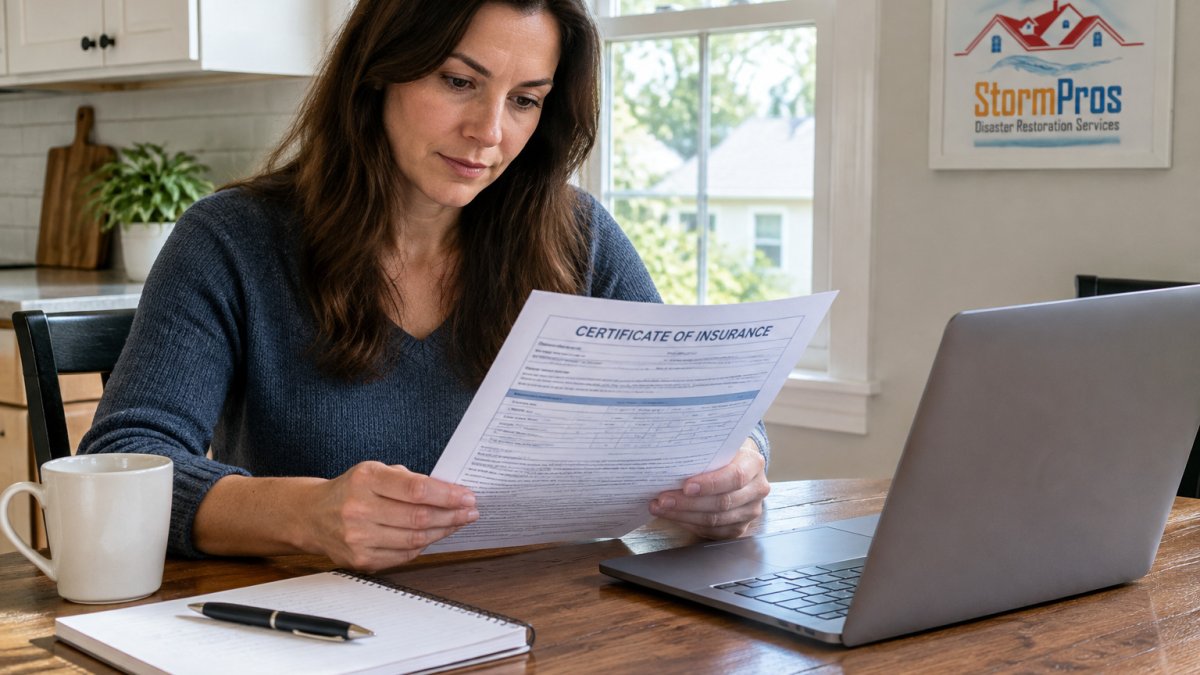
- Producer and insurer. The producer is the insurance agent who issued the certificate; the insurer is the company that would actually pay a claim. Confirm the insurer is a real, licensed carrier, you can look it up on your state insurance department’s website. A certificate from an unfamiliar or misspelled insurer is a warning sign.
- Named insured. This is the legal entity whose policy it is. It must match the company name on your contract, your quote, and the license lookup. A common pattern is a certificate issued to “J. Smith” while the contract is with “Smith Roofing LLC”, those are different legal entities, and the policy may not respond to a claim against the LLC.
- Certificate holder. This is the party the certificate is issued to, often the homeowner or the homeowner’s lender. Being a certificate holder gives you notice of cancellation; it does not give you rights under the policy. Do not confuse it with additional insured status (covered below).
- Policy effective and expiration dates. Confirm the policy is active on the day work starts and will stay active through the expected completion date. A certificate that expires mid-project leaves you exposed for the back half of the job.
- Coverage types and limits. Look for Commercial General Liability (CGL) and Workers’ Compensation. On the CGL line, note both the per-occurrence limit and the general aggregate limit. On the workers’ comp line, note the policy number and the insurer, you will confirm both with the carrier.
Step 3: Ask for the endorsements that change the deal. Three additions are worth requesting in writing before work begins:
- Additional insured endorsement. This names you, the property owner, as an additional insured on the contractor’s liability policy. It gives you direct rights under their policy if a claim arises from their work, a meaningful step up from certificate holder status. Ask whether this can be added to the policy; a contractor who refuses should be a serious concern.
- Waiver of subrogation. This prevents the contractor’s insurer from paying a claim and then suing you to recover the money. It is often requested on commercial jobs.
- Primary and non-contributory language. This confirms the contractor’s policy pays first, before your homeowner’s policy is touched.
Step 4: Ask about subcontractors explicitly. Many roofing crews use subcontractors for tear-off, decking, or specialty work.
Watch out: A certificate of insurance is not a contract and does not guarantee coverage.
The certificate has several lines that control your exposure, and each one is worth checking in turn.
| COI line | What to confirm | Why it matters |
|---|---|---|
| Producer and insurer | Real, licensed carrier | A forged insurer name is a warning sign |
| Named insured | Matches your contract | Mismatched entities may not respond to a claim |
| Certificate holder | Gives notice of cancellation | Does not give policy rights |
| Effective and expiration dates | Covers the full job | A lapse leaves the back half exposed |
| Coverage types and limits | General liability and workers’ comp | Protects against property and injury claims |
| Description and remarks | No exclusions for your work | Exclusions can void the protection |
Verifying Coverage Directly With the Insurance Carrier and State Resources
This is the step most guides skip, and it is the one that actually protects you. A certificate can be edited; a carrier’s phone representative cannot be fooled by a PDF. Plan for a short carrier call and a brief state lookup.
Calling the Insurance Carrier
Use the phone number from the carrier’s official website, not the number printed on the certificate, a forged certificate will list a forged number. Most major carriers publish a claims or policy-services line on their site. When you call, identify yourself as a homeowner requesting verification of a contractor’s coverage and ask these questions in order:
- Is policy number [number from the COI] active today, and what are the effective and expiration dates?
- Who is the named insured on the policy?
- Does the policy include commercial general liability coverage, and what are the per-occurrence and general aggregate limits?
- Does the policy include workers’ compensation coverage?
- Is the policy written for residential roofing work, or does it exclude it?
Be aware of what the carrier will and will not tell you. Representatives typically have limits on the information they share, so confirm what you can with them and treat any gaps as a reason for caution.
Watch out: If the person who answers cannot confirm the policy exists, do not accept a “the agent will call you back” response as verification. Get the confirmation in writing or move on to another roofer.
Checking State Licensing and Insurance Records
Many states regulate roofing contractors through a licensing board or consumer protection agency, and some publish an online lookup. The exact agency and what it shows vary, so start with your state’s official .gov site and search for “contractor license lookup” or “verify a contractor license.” Common patterns include:
- Separate licensing board with a public database. Some states maintain a searchable roster showing license status, expiration date, and whether a bond or insurance is on file. If the contractor’s license is expired or shows no insurance on file, stop.
- Department of professional regulation or consumer affairs. Other states fold contractor registration into a broader agency. The lookup may confirm registration and complaint history rather than insurance specifics.
- No statewide roofing license. Some states do not license roofers at all, and in those places a license lookup will not help. In that case, the carrier call and the certificate review become your primary checks, and you should ask the contractor for a local business license or registration instead.
What the state lookup will not do is confirm that the contractor’s policy is currently active, that is the carrier’s job. Treat the two checks as complementary: the state confirms the contractor is allowed to work and may show whether insurance is on file; the carrier confirms the policy is real and in force today. You can also follow a step-by-step way to verify storm restoration warranties.
Documenting What You Find
Keep a simple file for each roofer you consider: the certificate PDF, the date and time of your carrier call, the name of the representative you spoke with, and a screenshot of the state lookup result. If a dispute arises later, this record is far more useful than a memory of a phone call. If any check fails, expired policy, mismatched named insured, no workers’ comp, license not found, write it down and move to the next bidder rather than trying to negotiate around it.
Red Flags and What Happens If a Roofer Is Uninsured
Watch for these warning signs:
- The contractor refuses to provide a COI or offers a photo of one
- The COI is from an unfamiliar insurer or uses a generic name
- The business has no physical address or only a phone number
- Pressure to pay the full amount upfront, especially after a storm
- Door-to-door sales with urgent deadlines
- A quote that is much lower than other bids with no clear reason
If you discover the roofer is uninsured, stop work before signing anything or making a final payment. Learn concrete steps to take if a contractor abandons your roof project. If work has already started, document everything with photos. Contact your homeowner’s insurance company to ask how an injury or property damage claim would be handled. Report unlicensed or uninsured contractors to your state licensing board.
Questions to Ask a Roofer About Insurance Before You Sign
Ask these questions before you agree to any work:
- Can you send a current certificate of insurance today?
- Who is your insurance carrier, and what is your policy number?
- Do your general liability and workers’ compensation policies cover the crew on this job?
- Can you add me as an additional insured?
- What are your coverage limits per occurrence and in total?
- Are your subcontractors also insured? Subcontractor liability matters, because an uninsured subcontractor can leave you exposed.
A reliable roofer answers every question clearly and in writing. Vague answers mean you should keep looking.
Booking a Verified Roofer for Your Storm Repairs With StormPros
StormPros is a family-owned and operated general contractor with more than 20 years of combined experience in storm damage restoration.
Before you hire any roofer, including us, use the checks in this guide. We also offer roof repairs and replacements for commercial properties.
Frequently Asked Questions
Is a certificate of insurance the same as insurance?
No. A COI is proof that a policy exists.
What insurance should a roofer have?
At minimum, general liability and workers’ compensation. Ask for both on a current COI before work begins.
Frequently Asked Questions
How do I find out if a roofer is insured?
Ask the roofer for a current certificate of insurance (COI) that lists their general liability and workers’ compensation coverage, then confirm it. Check that the policy is active on the work dates, that the named insured matches the company on your contract, and that your home is listed as the certificate holder or additional insured where appropriate. You can also call the insurance carrier or agent listed on the certificate, using the policy number, to confirm the policy is in force. Verify the roofer’s state license separately through the state contractor licensing board.
What kind of insurance should a roofing contractor have?
A professional roofing contractor should carry general liability insurance, which covers property damage and bodily injury caused by their work, and workers’ compensation insurance, which covers employees injured on the job. Many contractors also carry commercial auto insurance and an umbrella policy. Bonding is a separate protection that some states or clients require. Ask for proof of each coverage type rather than accepting a verbal assurance.
Can I call an insurance company to verify a contractor’s policy?
Yes. The certificate of insurance lists the insurance carrier, agent, and policy number. Contact the agent or carrier directly, not only through a phone number printed on the certificate, and ask them to confirm the policy is active, the coverage limits, and the effective and expiration dates. Ask whether the policy includes you as an additional insured if you need that protection. Keep a record of the date, the person you spoke with, and what they confirmed.
What happens if an uninsured roofer gets injured on my property?
If a roofer without workers’ compensation is injured on your property, you may be held responsible for their medical bills and lost wages, depending on your state’s laws and the circumstances. Homeowners’ policies often exclude injuries to people hired for work. Asking for a current certificate of insurance before work begins is the simplest way to avoid this exposure.


