 5.0 Out Of 250+ Reviews


 Financing Available


 (214) 227-2763

Table of Contents
- How Storm Chaser Roofing Scams Work After a Storm
- Roofing Contractor Scam Warning Signs to Catch Early
- How to Verify a Roofing Contractor Before You Sign
- Your Roofing Contract Checklist: Clauses to Review
- A Step-by-Step Insurance Claim Workflow for Storm Damage
- What to Do After a Roofing Scam: Recovery Steps
- Frequently Asked Questions
Last Updated: October 12, 2026
How Storm Chaser Roofing Scams Work After a Storm
Avoiding storm chaser roofing scams starts with understanding the playbook. A storm chaser is an out-of-area contractor who follows severe weather, sells quick roof repairs, collects payment, and leaves town before problems surface.
The Federal Trade Commission’s consumer guidance on home repair scams describes the same sequence we see in the field: an unsolicited knock, a frightening damage claim, and pressure to decide on the spot.
The Door-to-Door Pitch and the Limited-Time Offer
The pitch follows a script: someone knocks within days of a storm, claims to have been “working in the neighborhood,” and offers a free roof inspection.
Door-to-door solicitation is not automatically illegal, and some legitimate contractors do it. The problem is the combination of an unsolicited contractor, a high-pressure pitch, and a deadline that exists only to stop you comparing estimates.
Scam Scripts and Digital Payment Tactics
Modern roofing scams have moved beyond cash. Common tactics include:
- Requests for full payment or a large deposit upfront, before any materials arrive
- Payment by wire transfer, gift card, or payment app, which offers no chargeback protection
- A verbal agreement instead of a written contract with a defined scope of work
Never pay a large deposit before materials are delivered to your property. Once funds leave by wire or payment app, recovery is difficult even when the contractor is identified.
Roofing Contractor Scam Warning Signs to Catch Early
The clearest warning signs appear before any work begins: a contractor who cannot produce a physical business address, refuses to show a license or proof of insurance, and pressures you to sign before you have gathered multiple estimates.
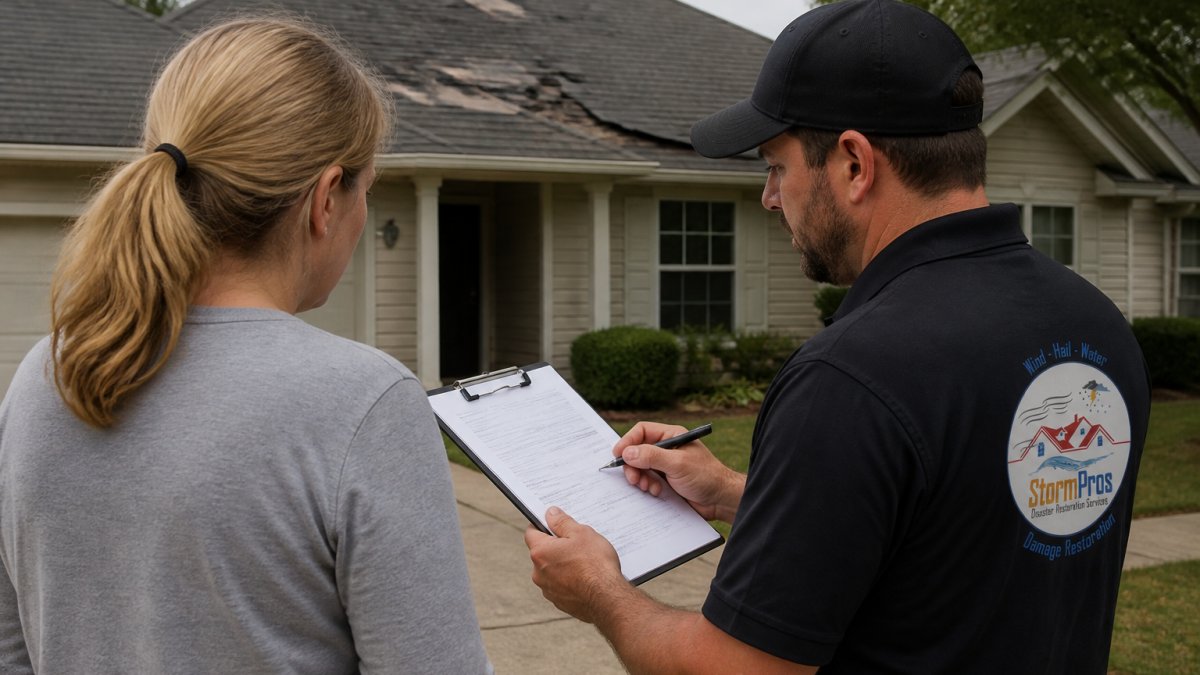
A legitimate contractor will slow down when you ask hard questions; a scammer will speed up. Treat any of these as a red flag:
- No written estimate, only a verbal number
- No local references or verifiable customer reviews
- A refusal to put the workmanship warranty in writing
Often the pressure itself is the tell: real contractors compete on reputation, scammers on speed.
How to Verify a Roofing Contractor Before You Sign
Verifying a roofing contractor takes about 30 minutes and prevents most storm chaser roofing problems. Confirm licensing, insurance, and a physical business address, then compare at least three written estimates.
Licensing, Insurance, and a Physical Business Address
Ask for the contractor’s license number and verify it with your state or local licensing board. Request a certificate of insurance for general liability and workers’ compensation, and call the insurer to confirm it is active. A physical business address, not just a phone number, is one of the strongest signals of a local contractor.
Legitimate Out-of-Area Contractors vs. Scammers
Not every out-of-area contractor is a scammer. After a major storm, local crews are often booked for months, and legitimate regional contractors travel to help. The difference is transparency: a legitimate one provides a physical address, a license valid in your state, proof of insurance, and a written contract. A scammer provides none of these and pushes for immediate payment.
| Signal | Legitimate Contractor | Storm Chaser Scammer |
|---|---|---|
| Business address | Verifiable physical location | Phone number only |
| License and insurance | Provided on request | Deflected or refused |
| Payment schedule | Tied to completed milestones | Large deposit upfront |
| Contract | Detailed written scope of work | Verbal agreement only |
| Warranty | Written workmanship warranty | Vague or nonexistent |
Your Roofing Contract Checklist: Clauses to Review
A roofing contract checklist protects you more than any verbal promise. Read every clause before signing, and never accept an oral agreement instead of a written contract.
Review these items line by line:
- Full legal name, license number, and physical address of the contractor
- Detailed scope of work, including materials, brands, and quantities
- Itemized labor costs and material costs, with a final cost total
Photograph every page of the signed contract and any change orders. If a dispute arises later, a dated photo of the signed scope of work is far stronger evidence than a verbal recollection.
A Step-by-Step Insurance Claim Workflow for Storm Damage
A controlled insurance claim workflow keeps you, not the contractor, in charge. The biggest mistake homeowners make after a storm is handing the claim to whoever knocked on the door. Your policy is a contract between you and your insurer; the contractor is a vendor you hire. Keep those roles separate.
Here is the workflow, with the mechanics behind each step.
- Document the damage before anything is touched. Photograph each roof slope from the ground with a wide shot, then close-ups of damaged shingles, hail strikes, dented vents and gutters, and interior water staining. Note the storm date and time and the date of your photos. If safe without climbing, get roof-level shots; otherwise hire a licensed inspector. Never let a salesperson be the only person who documents your damage.
- File the claim and get a claim number. Call your insurer’s claims line, not your local agent, and request a claim number in writing. Ask three questions: What is my deductible? Will this claim affect my premium, and how? What is the proof-of-loss deadline? Write the answers down.
- Read your policy’s storm-damage and matching provisions. Most policies cover sudden damage from hail, wind, and falling debris, but treat wear-and-tear differently. Many include a matching clause requiring the insurer to replace undamaged shingles if a repair would not match the rest of the roof. Knowing whether you have that clause changes the scope of the claim.
- Be present for the adjuster’s inspection. Walk the property with the adjuster. Point out every area you documented. Hand them a printed summary with your photos attached. Adjusters are often working dozens of claims after a major storm, and a homeowner who has done the homework gets a more thorough inspection.
- Get an independent assessment from a licensed roofing contractor. This is not a sales estimate. Ask for a written scope of work listing materials, quantities, and labor separately, and ask the contractor to flag anything the adjuster’s estimate missed. You are paying for a second opinion, not signing a contract.
- Compare the adjuster’s scope against your own documentation. Line up the adjuster’s line items against your photos and the contractor’s assessment. Common gaps: under-counted shingles, missing underlayment or ice-and-water shield, omitted gutter and downspout damage, and no allowance for permits or disposal.
- Approve the scope, then schedule work. Never authorize a full roof replacement before the claim scope is agreed in writing. If the numbers do not match, request a re-inspection with your contractor present rather than accepting the first offer, and ask for the insurer’s written explanation of any denied line item.
- Keep every receipt, change order, and approval. Claim documentation protects you if the insurer asks for proof later or if a dispute goes to appraisal or mediation.
Documenting Roof Damage and Working With the Adjuster
Thorough roof damage photos and clear claim documentation are the two levers that most affect your settlement. Take wide shots of each roof slope, then close-ups of damaged shingles, hail strikes, and interior water staining. Label each photo with the date and the roof area it shows.
When you meet the adjuster, hand them a printed summary of the areas you documented.
Keep a single folder, paper or digital, for the claim number, the policy declarations page, your photo log, the adjuster’s estimate, the contractor’s scope of work, and every email. When a claim drags on, the homeowner with the organized folder is the one who gets the re-inspection.
Who Controls the Claim
A contractor who offers to “handle everything with your insurance” is not automatically a scammer, but never sign a document that assigns your claim rights to a contractor or authorizes them to negotiate with your insurer for you.
The homeowner who stays in the loop, filing the claim, attending the inspection, approving the scope, keeps the settlement. The contractor’s job is to build the roof, not own the claim.
What to Do After a Roofing Scam: Recovery Steps
Recovery after a roofing scam is possible, but speed and documentation matter most. The first 72 hours are the most valuable: payments can still be stopped, bank records are fresh, and the contractor’s trail is warm. Work through these steps in order, and log every call, name, and reference number.
- Stop all payments immediately. Call your bank or card issuer for a stop payment on any check or transfer and a chargeback on any card charge. For wires, call your bank’s fraud line the same day, once a wire is picked up recovery is difficult, but a same-day report sometimes catches it. For payment apps, use the dispute process and report to the app’s fraud team. Keep the confirmation numbers.
- Preserve the evidence. Save the signed contract, change orders, texts, emails, voicemails, business cards, vehicle descriptions, and license plate numbers. Photograph the work site, leftover materials, and any magnetic or yard sign before it disappears. Do not clean up or repair anything until documented, unless it is a safety hazard.
- File a police report. A formal report supports insurance claims, civil suits, and recovery fund applications. Ask for the report number and a copy. In many jurisdictions, it is the document that turns a “civil dispute” into a fraud investigation.
- Report to your state’s consumer protection office and the licensing board. If the contractor claimed to be licensed, the board can investigate, suspend, or revoke the license, and in some states a board complaint is a prerequisite for the recovery fund. If they were unlicensed, report that too, unlicensed contracting is itself a violation in most states.
- Report to the FTC’s fraud reporting portal. The FTC’s report feeds a national database that law enforcement and other agencies use to connect complaints across state lines. Storm chasers often hit multiple states in one season, and a single report can help link cases.
- Notify your insurance company in writing. Explain what happened before filing any related claim. If the scammer filed a claim in your name or submitted an inflated estimate, tell the insurer immediately, that is fraud on their side, and they have an interest in resolving it.
- Check your state’s contractor recovery fund. Many states maintain a fund that reimburses homeowners for losses caused by a licensed contractor, and some extend it to unlicensed contractors in limited circumstances. It usually has a filing deadline and a per-claim cap, and requires that you first exhaust other remedies, including the police report and licensing board complaint. Ask the licensing board for the application and deadline.
- Consider a civil claim. For larger losses, a consumer-protection attorney can sometimes recover damages, attorney’s fees, and in some states treble damages under state consumer-protection statutes. State bar associations offer lawyer referral services, and some legal aid offices handle contractor fraud cases.
State and Local Consumer Protections
State and local consumer protections vary widely, and the rules that apply depend on where you live and where the work was performed. Common protections include:
- Licensing and registration requirements. Many states require roofers to hold a state license or register with a state board, and some cities require a separate local permit or registration.
- Written contract requirements. Many states require a written contract above a set dollar threshold, and some require specific clauses, such as a notice of the homeowner’s right to cancel.
- Cooling-off periods. Door-to-door sales are subject to a cooling-off rule in many states, giving you a set number of business days to cancel. The federal FTC’s Cooling-Off Rule gives you three business days to cancel certain door-to-door sales, and some states give longer.
To find the rules that apply to you, start with your state’s licensing board or consumer protection office, then check your city or county for permit and registration requirements. Ask specifically about the cooling-off period, the deposit cap, and the recovery fund deadline, those three answers cover most of what a homeowner needs.
Do not sign a release, a settlement, or a “final payment” acknowledgment with the scammer in exchange for a partial refund without first checking with the licensing board and, if the amount is significant, an attorney. A signed release can end your ability to pursue the recovery fund or a civil claim.
If the Scammer Is Still on Your Roof
If work is in progress and you believe you have been scammed, do not confront the crew. Ask them to stop work, put the request in writing (a text is fine), and call your local police non-emergency line if you feel unsafe. Photograph the roof before anyone leaves, then follow the steps above. The goal is to stop the loss, not win an argument on the driveway.
Frequently Asked Questions
How do you tell if a roofer is scamming you?
Watch for unsolicited door-to-door visits right after a storm, pressure to sign the same day, and requests for full payment or a large deposit upfront. A legitimate roofing contractor will provide a written estimate, proof of insurance, a physical business address, and a workmanship warranty. If they can’t show credentials or want cash before any work starts, walk away.
What are the warning signs of a storm chaser roofing scam?
Common storm chaser roofing scam warning signs include out-of-state license plates, no local business address, high-pressure sales tactics, limited-time offers, and demands for upfront payment. They often promise to handle your insurance claim and waive your deductible, which is illegal in many states. They also tend to disappear after the job, leaving no one to honor a warranty.
How can I verify a roofing contractor’s license and insurance?
Ask for the contractor’s license number and verify it with your state licensing board or local building department. Request a certificate of insurance for general liability and workers’ compensation, then call the insurer to confirm it’s active. Check for a physical business address, read customer reviews, and ask for referrals from past clients. A legitimate contractor will provide all of this without hesitation.
Should I sign a roofing contract after a storm?
Never sign a roofing contract on the spot. Take time to review the scope of work, payment schedule, cancellation terms, and warranty. Use a roofing contract checklist to confirm it includes a written estimate, start and completion dates, and a clear process for change orders. If the contractor pressures you to sign immediately, that’s a red flag.
What should I do if I think a roofing contractor scammed me?
Stop all payments, document everything in writing, and take photos of any incomplete or poor work. File a complaint with your state attorney general’s office and the state licensing board. Contact your insurance company if a claim was involved. You can also report the scam to the Better Business Bureau and consider consulting a consumer protection attorney.
Should I let a roofer speak to my insurance adjuster?
You can have a roofing contractor present during the adjuster’s inspection, but you should be there too. A reputable contractor can point out damage the adjuster might miss. However, never let a contractor speak for you or negotiate your claim alone. Keep control of the conversation and review any documentation before it’s submitted.


