 5.0 Out Of 250+ Reviews


 Financing Available


 (214) 227-2763

Table of Contents
- Why Hiring Local Contractors vs Storm Chasers Decides Your Repair Outcome
- What a Storm Chaser Looks Like in Practice
- Common Signs of a Roofing Scam After a Storm
- How to Verify a Contractor’s License and Local Ties
- Storm Damage Insurance Claim Process: Where Local Contractors Help Most
- Local Contractors vs Storm Chasers: Pros and Cons Side by Side
- Contract Clause Analysis: What to Read Before You Sign
- Conclusion
- Frequently Asked Questions
Last Updated: September 17, 2026
Why Hiring Local Contractors vs Storm Chasers Decides Your Repair Outcome
The choice between local contractors vs storm chasers often decides whether your storm damage claim gets paid in full or drags on for months. After a major hail or wind event, out-of-town crews flood the area with slick pitches and cash-upfront demands, then leave before the work is inspected, leaving homeowners chasing warranty claims that go nowhere.
What a Storm Chaser Looks Like in Practice
A storm chaser follows severe weather from town to town, sells quick repairs, collects payment, and leaves before problems surface. These operators rarely hold a local license, keep no nearby business address, and vanish once the next storm hits elsewhere.
Common Signs of a Roofing Scam After a Storm
The clearest signs of a roofing scam after a storm are unsolicited door-to-door solicitation, demands for upfront payment, and pressure to sign an Assignment of Benefits. Any one should stop the conversation; two or more mean you are dealing with a predatory operator.
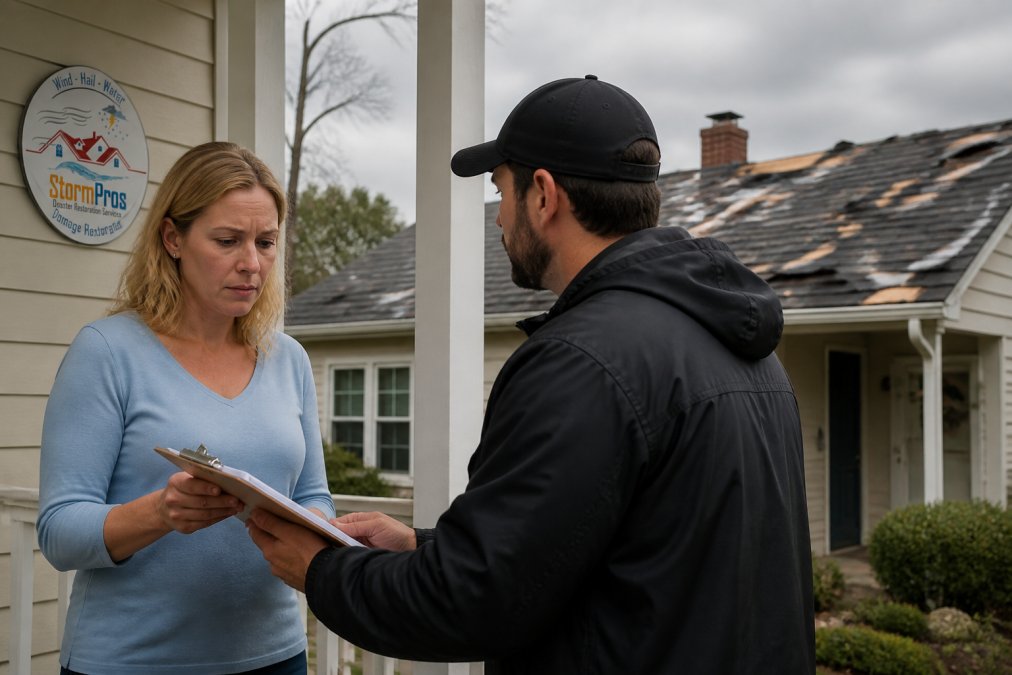
Door-to-Door Solicitation and High-Pressure Sales
A knock the day after a storm is a warning sign, not a service, reputable contractors stay booked through referrals and repeat customers. High-pressure lines like “we’re only in the neighborhood today” exist to stop you from doing research.
- Unsolicited visits right after a natural disaster
- Claims that your insurance will “cover everything”
- No physical business address or local phone number
- Refusal to provide a written estimate before starting
- Requests to sign paperwork on the spot
Assignment of Benefits and Upfront Payment Requests
An Assignment of Benefits (AOB) transfers your insurance claim rights to the contractor, giving them control over your claim; in the worst cases they inflate the bill and leave you responsible for the difference. Upfront payment is equally dangerous: once cash changes hands, your leverage disappears.
Never sign an Assignment of Benefits or pay more than a small deposit before work begins. If the contractor vanishes or the work fails inspection, recovering that money is difficult and often impossible.
How to Verify a Contractor’s License and Local Ties
Verifying a contractor’s license takes about fifteen minutes and eliminates most fraud risk. Every state licensing board has a public database for the license number, expiration date, and complaint history. Cross-check the name on the license against the contract, and confirm the classification covers the work being sold, a general contractor license does not always authorize roofing or structural repair.
Digital Footprint Verification and Physical Business Address
A contractor with real local ties has a verifiable footprint that predates the storm. Most guides stop at the physical address check; the modern layer is auditing digital history, because a website and social presence can be manufactured in an afternoon.
- Domain age: Run the contractor’s website through a WHOIS lookup. A domain registered weeks before the storm is a red flag. Legitimate local firms typically have domains that are years old.
- Wayback Machine history: Check the Internet Archive for archived snapshots of the site. A site with no snapshots before the storm, or one whose archived content describes a different business entirely, is worth a hard second look.
- Google Business Profile: Confirm the address is a street address, not a service-area-only listing, and check the date the profile was created. Look at review history, a burst of five-star reviews all posted in the same week is a pattern, not a reputation.
- Social media history: Scroll back on the company’s Facebook or Instagram page. A page whose oldest post is from last month, or whose older posts reference a different region, tells you the operation is new to your area.
- Phone number and email: A local area code means little if the number is a VoIP line. Search the number and the email address; recycled numbers tied to multiple business names are a common storm-chaser tactic.
Cross-Checking the License Against the Contract
- Confirm the license number on the state board’s website, and screenshot the result.
- Verify a street address, not just a mailing address, and confirm it matches the license record.
- Look for BBB accreditation and recent local reviews, but treat reviews as supporting evidence, not proof.
- Ask for two local references from jobs completed at least six months earlier, so you can see how the work held up.
- Check that bond and insurance certificates are current, and call the insurer to confirm the policy is active, certificates can be forged.
- Ask the contractor to name the individual who will pull the permit. If the answer is vague, the permit may never be pulled, which leaves you exposed at resale.
The Better Business Bureau’s guidance on hiring contractors recommends asking for references from jobs completed at least six months earlier, so you can see how the work held up. Pair that with the digital audit above, and you have a verification process that is far harder to fake than a business card and a magnetic sign.
Save a screenshot of the license record, the WHOIS result, and the Google Business Profile before you sign anything. If the contractor later disputes the terms or disappears, you have a dated record of what you verified and when.
Storm Damage Insurance Claim Process: Where Local Contractors Help Most
Local contractors help most in the storm damage insurance claim process by documenting damage thoroughly and coordinating directly with your adjuster. One who has worked hundreds of local claims knows what adjusters look for and how to present evidence supporting a full payout.
Coordinating With Your Insurance Adjuster
Ask your contractor to photograph every damaged area before any repair starts, including attic-side decking and flashing. Adjusters approve supplements far more often when the evidence is already organized.
This is where an experienced local team earns its keep: StormPros acts as a claim specialist, so the homeowner is not translating between a roofer and an insurance company.
Local Contractors vs Storm Chasers: Pros and Cons Side by Side
The comparison comes down to accountability. Local contractors live and work where you do, so their reputation is on the line on every job. Storm chasers have no such stake.
| Factor | Local Contractors | Storm Chasers |
|---|---|---|
| License and bond | Verifiable locally | Often out-of-state or missing |
| Physical address | Local street address | PO box or hotel room |
| Warranty | Workmanship warranty backed locally | Verbal promise, hard to enforce |
| References | Local homeowners you can call | Out-of-area references |
| Insurance claim help | Coordinates with adjuster | Often pushes AOB paperwork |
| Timeline | Scheduled, realistic | “Start tomorrow” pressure |
| Accountability | Reputation at stake | Leaves after the storm season |
Contract Clause Analysis: What to Read Before You Sign
Most guides tell you to ‘read the contract carefully’, useless advice if you do not know which clauses carry the risk. The clauses below separate a fair contract from a predatory one, each with specific language to watch for.
Payment Schedule
Tie payments to completed milestones, not calendar dates: a modest deposit, a draw after materials are delivered and tear-off is complete, a draw after dry-in, and final payment after inspection and your written approval.
Assignment of Benefits
An Assignment of Benefits (AOB) transfers your insurance claim rights to the contractor. Signing one gives the contractor control over your claim, and in the worst cases, they inflate the bill and leave you responsible for the difference.
Cancellation Rights
Federal law gives you a three-day right to cancel certain door-to-door sales contracts, and many states extend that window. A legitimate contractor states the cancellation period in plain language and provides the required notice form.
Warranty Terms
Get the workmanship warranty in writing, with duration, coverage, and who honors it. Manufacturer warranties on shingles or siding are separate, and a storm chaser will often blur the two.
Scope of Work and Materials
List every material, every area, and every task. Vague scopes invite hidden fees and change orders.
Lien Waivers
Require written lien waivers from subcontractors and suppliers as work is completed. Without them, an unpaid supplier can file a mechanic’s lien against your property even after you have paid the general contractor in full.
Dispute Resolution and Arbitration
Red-flag language: A mandatory binding arbitration clause that names an arbitrator in another state, or that requires you to waive your right to a jury trial. These clauses are common in storm-chaser contracts because they make it impractical for you to pursue a claim.
A Quick Pre-Signature Checklist
- Payment schedule tied to milestones, not dates
- No Assignment of Benefits language anywhere in the document
- Cancellation clause that matches your state’s required period
- Workmanship warranty in writing, with duration and coverage
- Scope of work that names specific materials and quantities
- Lien waivers required at each payment draw
- No out-of-state arbitration clause
If a contractor resists any of these, walk away. There is no shortage of reputable roofing companies who will sign a fair contract without argument.
Conclusion
The gap between a smooth storm damage claim and a months-long nightmare usually comes down to one decision made in the first week after the storm. Storm chasers count on homeowners skipping verification; local contractors earn trust through licensing, references, and a contract that protects you.
Frequently Asked Questions
What are the primary risks of hiring storm chasers for roof repairs?
Storm chasers often leave the area once the work is done, so workmanship warranties can be impossible to enforce. Many lack proper contractor licensing, bond and insurance in your state, and some ask for full upfront payment before any work starts. Without a physical business address or local references, homeowners have little recourse if shingle damage is repaired poorly or hidden water damage appears months later.
How can I verify if a contractor is truly local?
Check the contractor’s physical business address, not just a PO box. Search your state licensing board database, look for BBB accreditation, and ask for three local references from jobs completed at least a year ago. A quick digital footprint check helps too: look for an established website, local phone number, and reviews tied to your area rather than a generic out-of-state listing.
Do storm chasers typically provide valid insurance and warranties?
Some carry insurance, but many out-of-state contractors show up without a local bond or verifiable coverage. Even when a workmanship warranty is offered in writing, enforcing it is difficult once the company has left your region. Before signing, ask for a certificate of insurance, confirm the bond and insurance are active, and read the warranty terms carefully. A reputable contractor will provide these documents without hesitation.
What should I look for in a legitimate storm damage restoration contract?
Look for a written estimate with line items, a clear project timeline, a workmanship warranty, and no blank spaces. Read every clause about subcontracting, lien waivers, and payment schedules. Avoid contracts with an assignment of benefits clause that hands your insurance claim rights to the contractor. A legitimate contract also names the licensed entity, includes a physical business address, and never requires full upfront payment before materials arrive.


