 5.0 Out Of 250+ Reviews


 Financing Available


 (214) 227-2763

Last Updated: November 11, 2026
Quick Summary
Choose roof repair when storm damage is localized to one or two spots and the roof has plenty of useful life left. Choose roof replacement when damage is widespread, leaks are recurring, or the decking is saturated, delaminated, or spongy, since new shingles will not fix a failing deck.
- Damage spread across slopes, valleys, and penetrations points to replacement rather than repair.
- Saturated, delaminated, or spongy decking pushes toward replacement regardless of roof age.
- Once a roof passes roughly three-quarters of its rated lifespan, the economics flip toward replacement.
- Photograph every damaged area before anyone touches the roof and keep emergency tarping receipts.
- Meet the adjuster on the roof and compare their written scope against your contractor’s line by line.
Table of Contents
- Storm Damage Roof Inspection: How to Assess What You’re Dealing With
- When Roof Repair Is the Right Call After a Storm
- When Full Roof Replacement Is Necessary
- Roof Replacement Versus Repair After Storm Cost: What to Expect
- Filing a Homeowners Insurance Roof Damage Claim
- Roof Leak Repair: What to Do Before and After the Decision
- Get a Professional StormPros Inspection Before You Decide
- Frequently Asked Questions
Storm Damage Roof Inspection: How to Assess What You’re Dealing With
The first question after a storm is almost never “repair or replace?” It is “how bad is it?” Answer that honestly and the roof replacement versus repair after storm decision usually makes itself.
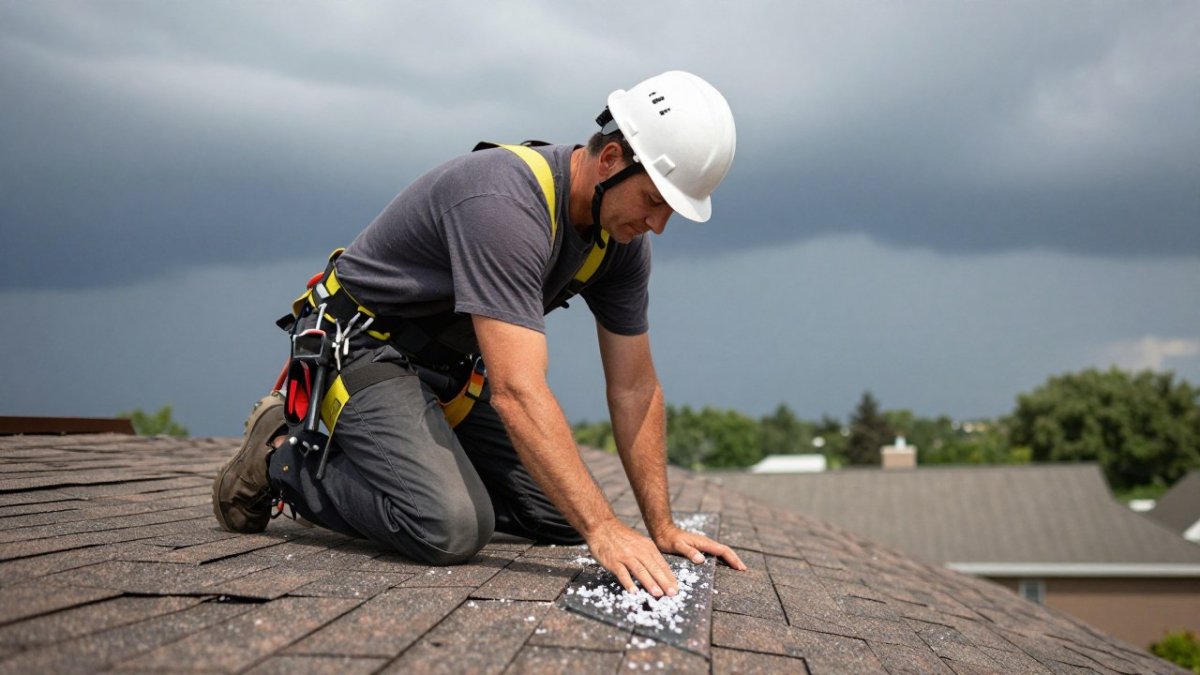
A storm damage roof inspection is a systematic check of shingles, flashing, gutters, and the roof deck to separate cosmetic wear from damage that lets water in. You are looking for patterns, not single spots. Damage in one small area points to repair.
Signs of Wind, Hail, and Water Damage
Wind damage shows up as missing shingles, lifted tabs, and granules collecting in gutters or at downspout outlets. Hail damage is subtler: soft spots, bruised shingle mats, and dents on metal vents, gutters, and downspouts. Water damage rarely announces itself. Look for brown ceiling rings, sagging drywall, and daylight in the attic.
Granule loss matters more than people expect. Bare spots on asphalt shingles mean the protective surface is gone, and the shingle will age fast from there.
Structural Damage and Roof Decking Condition
Walk the attic with a flashlight. Look for stained rafters, sagging between trusses, and soft spots you can feel underfoot. Saturated decking is a replacement signal, not a repair one. If the plywood or plank decking has swelled, delaminated, or turned spongy, new shingles will not fix the problem underneath.
When Roof Repair Is the Right Call After a Storm
Repair is the right call when the damage is localized: a handful of missing shingles, one damaged vent boot, a single flashing failure, or a small area of lifted tabs.
The other condition is age. A roof with plenty of remaining useful life is worth repairing. A roof near the end of its lifespan is not.
For metal roofs with hail dents, repair is often viable when the panels are not punctured and the seams and fasteners are intact. We cover the specifics in our guide on hail damage on metal roofs.
Best for: isolated damage on a roof with years left. Skip if: leaks have spread or the decking is soft.
When Full Roof Replacement Is Necessary
Replacement becomes necessary when damage is widespread or when the roof is already near the end of its service life. The clearest signals: multiple leaks in different areas, saturated or delaminated decking, widespread granule loss across sun-facing slopes, and repeated repairs that never quite hold.
Roof Age and Remaining Useful Life
Age is the quiet deciding factor. Asphalt shingles have a rated lifespan, and once a roof passes roughly three-quarters of it, the economics flip. A repair on a 20-year-old shingle roof buys time, not value. A replacement resets the clock and restores a weatherproof seal over the whole structure.
Installation problems also push toward replacement. Poorly nailed shingles, missing underlayment, or improper flashing at valleys and chimneys cause damage that keeps coming back. If you are weighing a full reroof, our walkthrough of the roof installation process explains what the job actually involves, start to finish.
Roof Replacement Versus Repair After Storm Cost: What to Expect
The honest answer on roof replacement versus repair after storm cost is that the spread is wide, and it depends on roof size, pitch, material, and how much decking needs replacing. Any contractor who quotes a firm number before seeing your roof is guessing. What you can do is build a realistic range from the drivers below, then compare it against your deductible and the roof’s remaining service life.
What drives the gap:
- Repair cost scales with the number of damaged areas, the pitch and height of the roof, and access difficulty. A single flashing repair on a low-slope garage is a different job from three separate leak calls on a steep two-story.
- Replacement cost scales with square footage, material choice, tear-off and disposal, and decking repairs. Decking is the wild card: a roof that needs several sheets of sheathing replaced can add meaningfully to the total.
- Long-term value favors replacement when repairs would stack up over the next few years. Two or three repair calls on a roof with little life left usually cost more than one replacement spread over the same period.
| Factor | Repair | Replacement |
|---|---|---|
| Damage scope | Localized, one or two areas | Widespread across slopes |
| Roof age | Plenty of life left | Near end of lifespan |
| Decking | Dry and solid | Saturated or soft |
| Leaks | Single, traceable | Multiple, recurring |
| Long-term value | Short-term fix | Resets roof lifespan |
Example Scenarios That Show the Math
These are illustrative patterns, not quotes. Use them to frame the conversation with your contractor.
- Young roof, one damaged slope. A roof with most of its service life remaining and damage confined to one slope is usually a repair. The repair bill is a fraction of replacement, and the rest of the roof still has years of protection left.
- Mid-life roof, scattered damage. When damage is spread across several slopes but the decking is sound, the decision often comes down to how many repair visits you expect over the remaining life. Two or more repairs in a short window usually tip the math toward replacement.
- Old roof, any significant damage. Once a roof is near the end of its rated lifespan, a repair buys time rather than value. The replacement resets the clock and restores a weatherproof seal over the whole structure.
- Decking damage in any scenario. Saturated, delaminated, or spongy decking pushes toward replacement regardless of roof age, because new shingles over a failing deck will not hold.
Get a written roofing estimate that itemizes labor, materials, decking, and disposal. Then ask for a second written scope from another contractor and compare line by line, not just the bottom line. A lower total that omits decking replacement or underlayment is not actually lower.
Watch out: a contractor who quotes a replacement price from the driveway, before anyone has been in the attic or on the roof, is selling a number, not an assessment.
Filing a Homeowners Insurance Roof Damage Claim
A homeowners insurance roof damage claim starts with documentation, not a phone call. Photograph every damaged area before anyone touches the roof, keep the receipts for emergency tarping, and note the storm date. Your policy deductible applies, and the insurance adjuster will assess damage against covered perils, typically wind and hail.
The Claim Process, Step by Step
- Document before you touch anything. Photograph shingles, flashing, gutters, downspouts, and any interior water stains. Date-stamp the photos if your phone allows it. Keep a written log of the storm date and when you first noticed each issue.
- Prevent further damage. Emergency tarping and minor leak control are usually expected of you under the policy’s duty to mitigate. Keep every receipt; those costs are often reimbursable.
- File the claim promptly. Most policies do not require immediate filing, but delay makes causation harder to prove. Report the storm date and the damage you observed.
- Meet the adjuster on the roof. Be present for the inspection if you can. Point out every area you documented, including attic staining and soft decking the adjuster might otherwise miss.
- Get the adjuster’s written scope. The adjuster produces an estimate of covered damage. Compare it against your contractor’s written scope line by line. Missing decking, underlayment, or code-required items are common gaps.
- Submit supplements for missed items. If your contractor finds covered damage the adjuster’s scope omitted, a supplement with photos and a written explanation is the standard path to correcting the estimate.
When a Claim Is Partially or Fully Denied
Denials happen, and they are not always final. A partial denial often means the adjuster attributed some damage to wear and tear rather than the storm, or applied depreciation. A full denial usually cites cause, timing, or policy exclusions.
- Ask for the denial in writing with the specific policy language and cause cited.
- Request a reinspection with your contractor present, armed with photos and a written scope.
- Use the appraisal clause if your policy includes one; it lets both sides hire independent appraisers to settle a valuation dispute.
- Escalate to your state’s department of insurance if the process stalls. Consumer complaint divisions exist for exactly this.
Watch out: signing a contract or authorizing repairs before the adjuster inspects can complicate your claim, and some policies require you to notify the insurer before permanent repairs begin. Document first, then repair. Our guide on how to negotiate a fair storm damage settlement walks through the steps we would take.
Roof Leak Repair: What to Do Before and After the Decision
Active leaks need action now, whatever you decide later. Move furniture and valuables, place buckets, and if the ceiling is bulging, pierce a small hole to drain trapped water safely. Never climb a wet roof.
For roof leak repair in the rain, a tarp secured over the leak area is the standard temporary fix and helps prevent further damage. Keep the tarp receipt for your claim. Our guide on stopping a roof leak in the rain fast covers the safe steps in detail.
After the decision, get the repair or replacement in writing with a warranty. Then schedule a follow-up inspection after the next heavy rain.
Get a Professional StormPros Inspection Before You Decide
The repair-or-replace call is hard to make from the ground, and an honest professional evaluation costs far less than guessing wrong.
StormPros is a family-owned general contractor with more than 20 years of combined experience, fully insured, that handles insurance claim paperwork alongside roofing work, and offers roofing, painting, siding, and gutter services.
If you are unsure whether paying for an inspection is worth it, read our guide on whether a professional roof inspection is worth it, then call us for a free quote.
Storm damage rarely gets better on its own, and a small leak today becomes a decking replacement next season.
Frequently Asked Questions
How can I tell whether storm damage requires a roof replacement?
Look for widespread damage rather than isolated spots. Multiple leaks, missing shingles across several slopes, heavy granule loss, and saturated decking all point toward replacement. If the damage covers more than roughly a third of the roof or the shingles are near the end of their lifespan, patching rarely makes financial sense. A professional storm damage roof inspection confirms what you’re seeing and documents it for your insurer.
Will homeowners insurance cover roof repairs or replacement after a storm?
Most policies cover sudden storm damage, including wind and hail, but not wear and tear or lack of maintenance. Your deductible applies, and the insurance adjuster will compare repair scope against replacement cost. Document everything with photos before any temporary fixes, keep receipts, and ask your contractor to attend the adjuster inspection. Coverage details vary by policy, so read your declarations page carefully.
Can a roofer patch storm damage instead of replacing the whole roof?
Yes, when damage is localized and the rest of the roof has years of useful life left. A roof leak repair or shingle patch is faster and cheaper upfront. The catch is material matching: new shingles may not blend with faded ones, and some codes require matching within a visible area. Ask your contractor to explain the repair scope and how the patch will look before you approve it.
What should I do immediately after a storm damages my roof?
Stay off the roof. Photograph damage from the ground, check ceilings for water stains, and move valuables away from leaks. Place buckets under drips and tarp any open areas if it’s safe to do so, keeping receipts for temporary mitigation. Then call your insurer and schedule a storm damage roof inspection. Quick documentation and temporary protection prevent further damage and strengthen your claim.


