 5.0 Out Of 250+ Reviews


 Financing Available


 (214) 227-2763

Quick Summary
Gutter pitch adjustment means resetting the slope of your gutters so rainwater flows toward the downspout. Most gutters need about 1/4 inch of fall for every 10 feet, and you can usually fix it by adjusting the hangers, one small step at a time, without removing the gutters.
- Standard gutter fall is about 1/4 inch per 10 feet of run toward the downspout.
- Clear the downspout first, since a clog can mimic a pitch problem.
- Adjust hangers in 1/8 inch steps and recheck the string after every two or three.
- Test the fix by running a hose into the high end and watching water flow steadily out.
- Sagging over 1 inch or soft fascia calls for repair beyond a hanger adjustment.
Table of Contents
- What Gutter Pitch Is and Why Standing Water Signals a Problem
- How to Measure Gutter Slope Per Foot
- Gutter Pitch Adjustment Tools and Materials You Need
- Step-by-Step: Adjusting Gutter Pitch Without Removing the Gutters
- How to Fix Standing Water in Gutters
- Safety When Working at Height and Gutter Types to Know
- Confirming Your Adjustment Works and When to Call StormPros for a Quote
- Frequently Asked Questions
What Gutter Pitch Is and Why Standing Water Signals a Problem
Gutter pitch is the slight downward slope that moves rainwater toward the downspouts. Most gutters need about 1/4 inch of fall for every 10 feet of run. Without that slope, water sits in the trough, and sitting water is what causes sagging, leaks, and overflow.
When gutters overflow during light rain, pitch is often the reason. Why gutters overflow in light rain explains how a shallow or reversed slope leads to spillover and what to look for. Water that cannot drain collects at the low spot and spills over the front edge.
Standing water also brings other problems:
- Leaves and grit settle in the still water and form sludge
- Mosquitoes breed in the standing pools (the CDC)
- The gutter pulls away from the house under the extra weight
- Ice builds up in cold weather and bends the gutter further
Watch out: A gutter can look level and still be pitched the wrong way. Sight along the trough from the end before you assume it is fine.
How to Measure Gutter Slope Per Foot
To check pitch, you need a level, a tape measure, and a helper if you can get one. Start at the high end, the corner farthest from the downspout. Mark the spot on the gutter where it is closest to the fascia.
Here is the simple method:
- Hang a string line from the high end to the low end, with the string touching the bottom of the gutter.
- Set the low end of the string so it sits about 1/4 inch lower for every 10 feet of run.
- Measure the gap between the string and the top of the gutter at several points.
- Divide the drop you measured by the run in feet to get the slope per foot.
Most homeowners can do this check in under an hour. Write down the numbers so you can compare after your adjustment.
Here is a quick reference for the key measurements and tools covered in this guide.
| Item | Value | Note |
|---|---|---|
| Standard gutter fall | 1/4 inch per 10 feet | Minimum slope toward the downspout |
| Hanger adjustment step | 1/8 inch at a time | Recheck the string after every 2-3 hangers |
| Fastener length | 1 1/2 inches | Exterior screws for hangers |
| Hose test water | 5-gallon bucket | Used to test downspout blockage |
| Sealant cure time | 24 hours | Wait before retesting a sealed joint |
| Maximum sag before pitch fix fails | More than 1 inch | Larger damage needs more than a hanger tweak |
Gutter Pitch Adjustment Tools and Materials You Need
For a basic gutter pitch adjustment, you will need:
- A 4-foot level and a line level for the string
- A tape measure
- A cordless drill with a driver bit
- Exterior screws, 1 1/2 inches long, for the hangers
- A ladder rated for your weight and stable on flat ground
- Work gloves and eye protection
- A bucket and a small garden hose to test the flow
Keep the materials simple. You do not need special gutter tools for most jobs. Stock up on screws that match your gutter material, since mixing metals can cause corrosion.
Step-by-Step: Adjusting Gutter Pitch Without Removing the Gutters
Most pitch problems can be fixed without taking the gutters down. The work is slow but manageable for a careful homeowner.
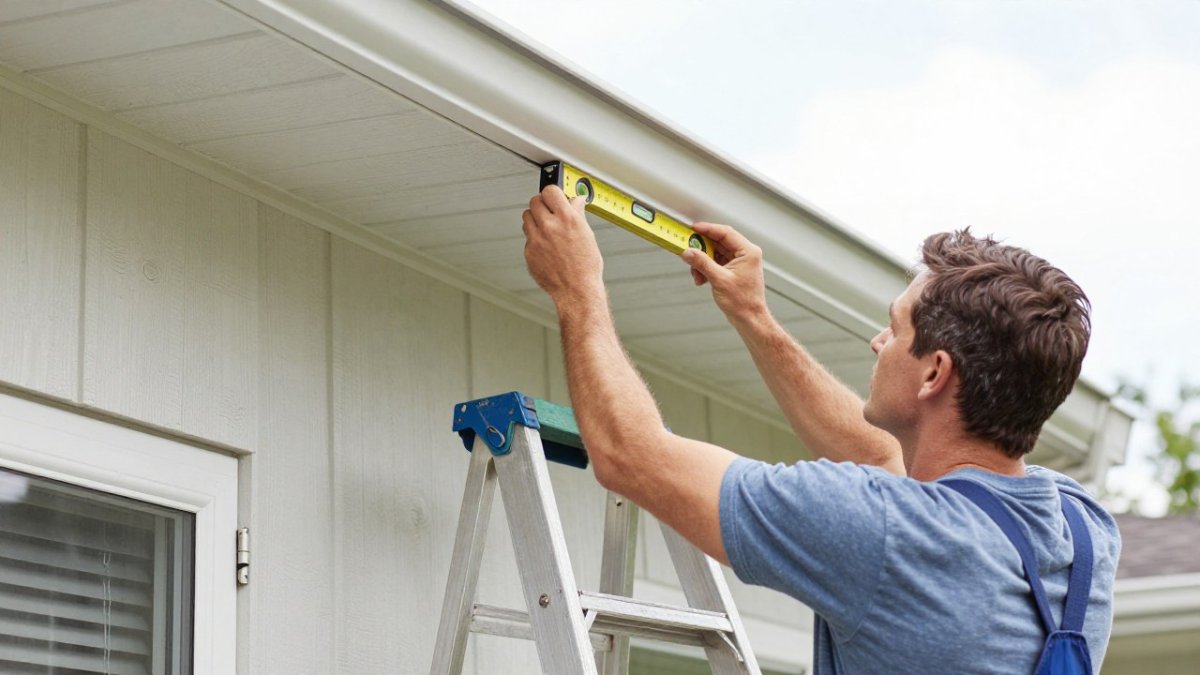
Step 1: Clean the gutter first. Remove leaves, grit, and debris with a scoop and a bucket.
Step 2: Find the low spots. Pour water into the high end and watch where it pools.
Step 3: Mark the target slope. Drive a nail or set a screw at the high end so the string touches the bottom of the gutter.
Step 4: Adjust the hangers. Work from the high end toward the downspout, one hanger at a time. Follow the section below for the exact method.
Step 5: Test the flow. Run the hose into the high end at full pressure and watch the water move steadily toward the downspout.
Adjusting Gutter Hangers to Set the Slope
Hangers hold the gutter to the fascia, and the hanger type determines how you change the height. Most residential gutters use one of four systems, and each adjusts differently.
- Spike and ferrule: A long spike drives through the gutter, a ferrule spacer, and into the fascia. To raise or lower the gutter, pull the spike with a claw hammer or cat’s paw, then drive it back in at the new height. Do not reuse a bent spike; replace it with a new one of the same length. If the spike spins freely, the fascia hole is stripped, and you need to move the spike up or down an inch into fresh wood.
- Screw-in bracket (hidden hanger): A bracket screws into the fascia and clips over the gutter’s back lip. Loosen the screw about a half turn, slide the bracket up or down, and retighten. These are the easiest to fine-tune because you can move them in small increments without removing the gutter.
- Strap hanger: A metal strap runs over the gutter and attaches to the roof deck. To change pitch, loosen the strap screws on the roof, adjust the strap tension, and resecure. Strap hangers are common on older homes and on gutters mounted below the roofline.
- Bracket with a sliding clip: Some aluminum and steel systems use a bracket with a clip that snaps over the front lip. Release the clip, move the bracket, and snap it back. These are common on seamless aluminum installations.
Work in small steps. Move each hanger about 1/8 inch at a time, then recheck with the string and line level. Overcorrecting is a common mistake, and it just creates a new low spot.
Watch out: If a hanger will not hold its new position, the fascia may be soft or the screw may be stripped. Probe the wood with a screwdriver; if it sinks in easily, the fascia is rotted and a longer screw will not help.
Keep the hanger spacing consistent as you work. Gutter manufacturers typically publish hanger spacing guidelines, so check your system’s instructions.
How to Fix Standing Water in Gutters
Standing water after a rain usually comes from one of four causes: a low section, a clogged downspout, a leak at a joint, or a gutter that was never pitched correctly in the first place. Work through them in order from simplest to hardest so you do not re-pitch a gutter that only needed a downspout cleared.
Test 1: Check the downspout first. Pour a 5-gallon bucket of water into the gutter right above the downspout outlet. If the water backs up at the outlet, the downspout is clogged.
Test 2: Check the joints. Dry the seam with a rag, then run water slowly along the joint. A drip at the seam means the joint is leaking, not that the pitch is wrong.
Test 3: Check the pitch with a water test. Plug the downspout outlet with a rag, fill the gutter with about 2 inches of water, and pull the rag. Watch the water move. If it stalls in one section and then runs again, that section is a low spot.
Test 4: Check for a flat or back-pitched run. Sight along the gutter from the high end with one eye closed, or use the string line from the measurement section.
Once you identify the cause, fix it and retest:
- Clogged downspout: Clear the blockage, then flush with a hose until water runs clear at the bottom.
- Low section: Re-pitch the hangers as described above, moving 1/8 inch at a time.
- Leaking joint: Seal the seam, cure, and retest with a slow trickle rather than a full hose blast.
- Flat or back-pitched run: Reset the string line and adjust every hanger from the high end to the downspout.
Clean the gutter again after the fix, then pour a bucket of water into the high end. Water should flow out the downspout without pooling. Check again after the next heavy rain to confirm the fix holds.
Watch out: If the gutter sags more than an inch, or the fascia is soft, pitch adjustment alone will not fix it. Sagging that returns within a few weeks of adjustment usually means the hangers are spaced too far apart or the fascia is failing, and the fix is new hangers or new fascia, not another adjustment. Gutter repair timing helps you judge when a problem like this calls for a repair rather than a DIY fix.
Safety When Working at Height and Gutter Types to Know
Falls from ladders cause serious injuries every year. Set the ladder on firm, level ground. Keep your belt buckle between the rails, and never lean out past your hips. Have a helper hold the base if possible.
Work on a dry day with no wind. Wet gutters and wet shoes are a bad mix. Never work near power lines.
Gutter type affects how you adjust it. Common types include:
- Vinyl: Lightweight and easy to bend, but it can crack in cold weather.
- Aluminum: Strong and common, usually held by spike or screw hangers.
- Steel: Heavy and durable, often with a bracket system.
- Copper: Long-lasting, but it needs specialist hardware and care.
Check the fascia too. Soft, rotted, or painted-over wood may not hold a new hanger. Hangers that are rusted, bent, or pulling loose should be replaced, not adjusted.
Confirming Your Adjustment Works and When to Call StormPros for a Quote
Test your work with the hose. Water should move steadily to the downspout with no pooling or drips at the joints. Check again after the next heavy rain.
If the gutter still overflows, pulls away from the house, or has damage that goes beyond the hangers, it may be time for professional help. A DIY fix works well for small pitch problems. Major sagging, rotted fascia, or repeated leaks usually call for expert repair or replacement.
For a professional look at your gutters, contact StormPros for a free quote. If you need the gutters cleaned first, book a gutter cleaning from StormPros.
Frequently Asked Questions
How much slope should a gutter have?
Gutters generally need a slight, consistent fall toward the downspouts. That slope lets water move toward the downspout without pooling. Gutters that are perfectly level will hold standing water between hangers, so a slight, consistent drop is the goal. Measure from the high end to the downspout with a level and a tape to confirm the fall before you finish adjusting. Adjust in small steps and recheck after each change.
Can you adjust gutter pitch without removing the gutters?
Yes, in most cases you can adjust pitch without taking the gutters down. You loosen or reposition the hangers or brackets, shift the gutter section to the correct height, and secure it again. Work from the high point toward the downspout and check the slope with a level after each change. If the gutter is sagging badly, cracked, or pulling away from the fascia, the hardware or the fascia board may need repair before the adjustment will hold.
Why is water sitting in my gutters?
Standing water usually means the gutter is level or sloping the wrong way, the downspout is clogged, or debris has built up in the trough. Sagging sections between hangers are another common cause. Check the slope with a level, clear the outlet and the downspout, and look for loose or damaged hangers. If water keeps pooling after you correct the pitch and clean the system, the drainage problem may need a professional inspection.
When should you call a professional to fix gutter pitch?
Call a professional if the work requires a tall ladder or steep roof access, if the fascia board is soft or rotted, or if gutters are pulling away from the house. A professional is also worth calling if water is getting behind the gutter and into the wall or roof edge. StormPros offers gutter services as part of its exterior and storm-damage work. For an assessment, request a free quote from StormPros.


