 5.0 Out Of 250+ Reviews


 Financing Available


 (214) 227-2763

Last Updated: November 1, 2026
Quick Summary
To improve basement ventilation to stop mold, move stale humid air out and pull drier air in using exhaust fans, air exchangers, or HVAC integration, and keep relative humidity below 50%. Fix water sources like foundation cracks and poor drainage first, because ventilation moves air but does not stop water.
- Target 30% to 50% relative humidity and run a dehumidifier when readings climb above 50%.
- Cross-ventilation needs openings on opposite or adjacent walls, not two windows side by side.
- HRVs and ERVs recover most heat or moisture before stale air leaves, cutting the energy penalty.
- In a windowless basement, fix drainage and waterproofing first, then ventilate and dehumidify.
- Call a professional when mold keeps returning after cleanup or you see efflorescence and structural cracks.
Table of Contents
- Signs Your Basement Ventilation Is Failing
- How to Improve Basement Air Circulation
- Mechanical Ventilation vs. Natural Ventilation
- Ideal Basement Humidity for Mold Prevention
- Choosing a Basement Dehumidifier for Mold Prevention
- How to Ventilate a Basement Without Windows
- When to Call a Professional for Basement Ventilation
- Frequently Asked Questions
Signs Your Basement Ventilation Is Failing
If your basement smells musty, feels damp, or shows condensation on pipes and walls, your basement ventilation is likely failing.
The warning signs are easy to spot once you know them:
- A musty odor that lingers even after cleaning
- Condensation on cold water pipes, windows, or concrete walls
- White, gray, or black fuzzy patches on joists, drywall, or stored boxes
Mold spores are everywhere (the EPA). According to the U.S. Environmental Protection Agency’s mold guidance, mold needs moisture to grow, so controlling dampness is the first line of defense.
Here is how to improve basement ventilation to stop mold before it spreads.
How to Improve Basement Air Circulation
Improving basement air circulation means moving stale, humid air out and pulling drier air in with fans, vents, and open pathways. The goal is a steady air exchange rate, not a one-time blast.
Follow these steps:
- Clear the clutter. Boxes and furniture block airflow along walls and corners.
- Open interior doors. Keep the basement door and closet doors open so air can move.
- Add a box fan or floor fan. Point it toward the stairs or an exhaust point.
- Use a dehumidifier. Run it near the dampest wall.
- Check return air pathways. If your HVAC serves the basement, keep returns open and unobstructed.
- Seal obvious leaks. Fix foundation cracks and dripping pipes before adding fans.
A common mistake is running a fan in a closed, humid room. That just stirs damp air around. You need a path for moisture to leave. Cross-ventilation, where air enters one side and exits another, works far better than a single fan.
Mechanical Ventilation vs. Natural Ventilation
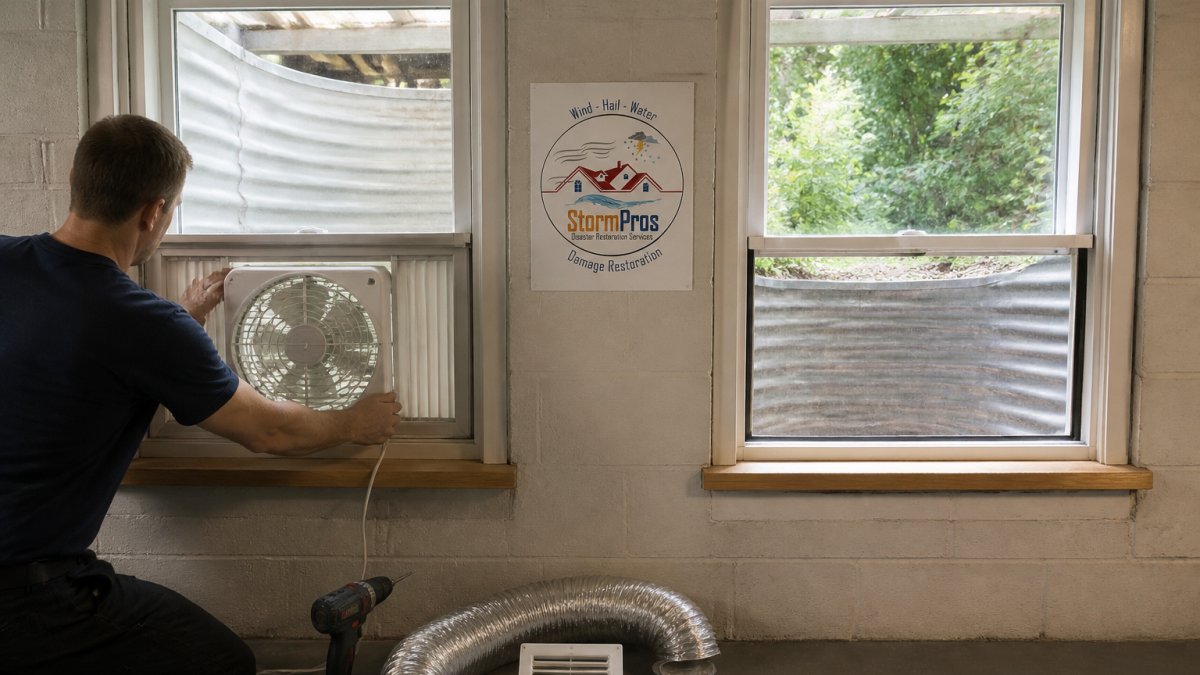
Mechanical ventilation uses fans and ducting to force air movement; natural ventilation relies on open windows and passive airflow. For basements, mechanical ventilation is often the more reliable choice, but the two approaches fail in different ways.
Why natural ventilation usually loses in a basement
Natural ventilation only works when outdoor air is drier than basement air, there is a clear inlet and outlet on opposite sides, and the temperature difference drives a stack effect. In a below-grade room that third condition is weak, basement air stays cool year-round, so buoyancy barely exists.
A common pattern: a homeowner opens two small hopper windows on the same wall, feels a breeze, and assumes the basement is ventilated. In practice, air short-circuits between the openings and corners behind the furnace never exchange. Cross-ventilation needs openings on opposite or adjacent walls, not side by side.
What mechanical systems actually do
Mechanical systems solve the pressure problem by creating a deliberate path from supply to exhaust:
- Exhaust fans depressurize the basement and push stale air out through a wall or window. Fan capacity should match the size of the space; undersized fans may run continuously and still leave humidity high.
- Air exchangers (HRVs and ERVs) swap stale indoor air for filtered outdoor air. An HRV transfers heat from the outgoing stream to the incoming one, which matters in cold winters; an ERV also transfers moisture, which matters in humid summers (HVAC Energy Recovery Ventilation). These let you ventilate without dumping your heating or cooling budget out the wall.
- HVAC integration ties basement airflow into your home’s existing system, but only works if the basement has supply and return registers sized for the load, a single supply vent with no return just pressurizes the room.
The energy trade-off, in plain terms
Every cubic foot of air you exhaust has to be replaced, and in winter that replacement air is cold. A continuously running exhaust fan pulls heated air out and cold outdoor air in through every gap, which is why a bath fan left on all day is a known energy waste. HRVs and ERVs recover most of that heat (or moisture) before the air leaves.
If you are comparing options, ask for the fan’s CFM rating and its sone rating (noise). A fan that is too loud gets switched off, and a fan that is switched off ventilates nothing.
When ventilation alone is not the answer
This is the part most guides skip. Ventilation moves air; it does not stop water. If the basement has foundation cracks, failed footing drains, or hydrostatic pressure pushing water through the slab, adding fans just circulates damp air faster. Waterproof first, ventilate second.
Do not seal a basement with visible mold or active seepage and then run a fan. Disturbing mold without containment can spread spores. Fix the water source and address the mold before you tune the airflow.
Ideal Basement Humidity for Mold Prevention
The ideal basement humidity for mold prevention is below 50% relative humidity. Mold struggles to grow when the air stays dry, so keeping humidity in check is your best defense.
Here is what to watch:
- Target range: 30% to 50% relative humidity
- Danger zone: above 60%, where mold and fungal growth thrive
- Measurement tool: a hygrometer, which costs little and gives instant readings
Watch the dew point too. When warm, moist air meets a cold basement wall, condensation forms, prime real estate for mold spores.
A simple routine helps:
- Check your hygrometer weekly.
- Run the dehumidifier when readings climb above 50%.
- Fix moisture sources like leaks, seepage, and dripping pipes.
| Humidity Level | Risk Level | Action |
|---|---|---|
| Below 30% | Low mold risk, may feel dry | Monitor only |
| 30% to 50% | Ideal range | Maintain current setup |
| 50% to 60% | Rising risk | Run dehumidifier, improve airflow |
| Above 60% | High mold risk | Act now: dehumidify and ventilate |
Choosing a Basement Dehumidifier for Mold Prevention
A basement dehumidifier for mold prevention should match your space size and dampness level, pulling moisture from the air to keep relative humidity in the safe zone.
Here is how to choose:
- Size by square footage. Small basements need a compact unit; large or very damp spaces need a higher-capacity model.
- Check the pint rating. This tells you how much moisture the unit removes per day.
- Look for a built-in hygrometer. It lets the unit run automatically to a set humidity level.
Watch out: a dehumidifier alone won’t fix a wet basement. If water is seeping through the foundation, you’re fighting a losing battle until the moisture source is sealed.
How to Ventilate a Basement Without Windows
Ventilating a basement without windows requires mechanical airflow, since there is no natural opening. But a windowless basement is also where ventilation most often fails, because finished walls, below-grade construction, and a tight foundation trap moisture and hide its source. The goal is not just to move air; it is to move air through a space you can actually dry.
Start with the pressure path
Air only moves if there is a path from where it enters to where it leaves. In a windowless basement, that path has to be built:
- Exhaust fan vented to the outside through a wall or existing duct. This is the simplest option most homeowners start with. The fan depressurizes the basement and pulls replacement air in through gaps around the rim joist, the stairwell, and the HVAC system, which works only if that replacement air is drier than the basement air.
- Air exchange system that brings in fresh air and pushes out stale air. A balanced system with separate intake and exhaust ducts avoids the depressurization problem and lets you filter or condition incoming air. Choose this when the basement is finished or outdoor humidity is high much of the year.
- HVAC integration so your furnace or AC circulates basement air. This requires supply and return registers in the basement; a supply-only setup pressurizes the room and pushes damp air into the walls.
The structural limitation most guides ignore
Here is the angle that separates a real fix from a fan in the corner: in a windowless basement, ventilation cannot overcome water coming through the structure. Foundation cracks, failed exterior waterproofing, clogged footing drains, and hydrostatic pressure push water vapor and liquid water into the space faster than any residential fan can remove it. If you see efflorescence (the white powdery stain on concrete), rusted anchor bolts, or a white ring at the base of the wall, moisture is coming through the concrete, and no amount of air exchange will stop mold until that path is closed.
A practical sequence to follow:
- Find the water source. Look for downspouts discharging near the foundation, grading that slopes toward the house, and visible cracks. A cheap hygrometer and a plastic-sheet test (taped to floor and wall for a few days) tell you whether the moisture is airborne or coming through the concrete.
- Fix drainage and waterproofing first. Extend downspouts, regrade, seal cracks, and repair footing drains. This is the step that actually stops mold at the source.
- Then ventilate and dehumidify. Once the structure is dry, mechanical ventilation keeps it that way.
A windowless basement is a ventilation problem and a waterproofing problem at the same time. Solve the water first; ventilation maintains the result.
Vapor barriers and air sealing
A vapor barrier on walls and floors blocks ground moisture from entering: a sealed polyethylene or rigid-foam barrier on the walls, a continuous barrier under any finished floor, and air sealing at the rim joist, the band where the foundation meets the wood frame, a notorious leak point for both air and moisture. Combine that with consistent airflow and you have a workable setup even in a windowless space.
Sizing and controls
A windowless basement usually needs a controller, not a switch. A humidity sensor that turns the fan or exchanger on above your target (below 50% relative humidity) keeps the system running only when it is doing useful work. For a finished basement, a balanced ERV with a humidity controller most reliably keeps mold from returning without running the fan around the clock.
When to Call a Professional for Basement Ventilation
Call a professional when DIY fans and a dehumidifier don’t stop the dampness, or when you see visible mold spreading. Persistent moisture often points to a deeper problem, like foundation leaks, poor drainage, or storm damage.
Signs it’s time to bring in help:
- Mold keeps returning after cleanup
- Water stains or efflorescence on walls
- Standing water or chronic seepage
Before hiring, it pays to understand how to choose the right water damage restoration company in your area, since a good provider inspects for hidden moisture and rot, not just surface mold. If you’re weighing DIY cleanup against a pro, read is professional mold remediation worth it to see what the work actually involves. For storm-related water damage, StormPros offers water damage restoration.
A proper inspection finds the moisture source and fixes it, so ventilation can do its job. That’s where StormPros comes in.
Get started with StormPros and protect your basement from mold before it spreads. Request your FREE quote today.
Frequently Asked Questions
How do I know if poor basement ventilation is causing mold?
Look for a musty odor, visible dark spots on walls or joists, condensation on pipes or windows, and peeling paint. A hygrometer reading above 60% relative humidity points to ventilation problems. Mold spores need moisture to grow, so persistent dampness is the clearest sign. If you notice these issues, improving basement ventilation and fixing moisture sources should be your first step.
Is a dehumidifier or ventilation better for a damp basement?
They solve different problems. Ventilation replaces stale, humid air with drier outdoor air, but it only works when outdoor conditions are drier. A basement dehumidifier for mold prevention removes moisture regardless of outdoor humidity. For most homes, the best approach combines both: use ventilation to improve air exchange and a dehumidifier to keep relative humidity below 50%. If your basement has no windows, a dehumidifier becomes even more important.
Can mold grow at 20% humidity?
No. Mold needs relative humidity above 60% to thrive, and most species require sustained moisture. At 20% humidity, mold spores remain dormant and cannot grow. However, 20% is uncomfortably dry for most homes. The ideal basement humidity for mold prevention is between 30% and 50%. Use a hygrometer to monitor levels and adjust ventilation or dehumidification accordingly.
Should you open basement windows to reduce humidity?
Only when outdoor air is drier than basement air. Opening windows on a humid summer day can make dampness worse. Check the dew point: if outdoor dew point is lower than your basement temperature, open windows for cross-ventilation. Otherwise, rely on mechanical ventilation or a dehumidifier. In winter, brief window opening can help, but avoid long periods that chill pipes.


